- Knitting pattern PDFs
- Fruition Cardigan
Fruition Cardigan
Fruition Cardigan
Scheduled for release in late November 2026.
From the Fruition Cardigan pattern:
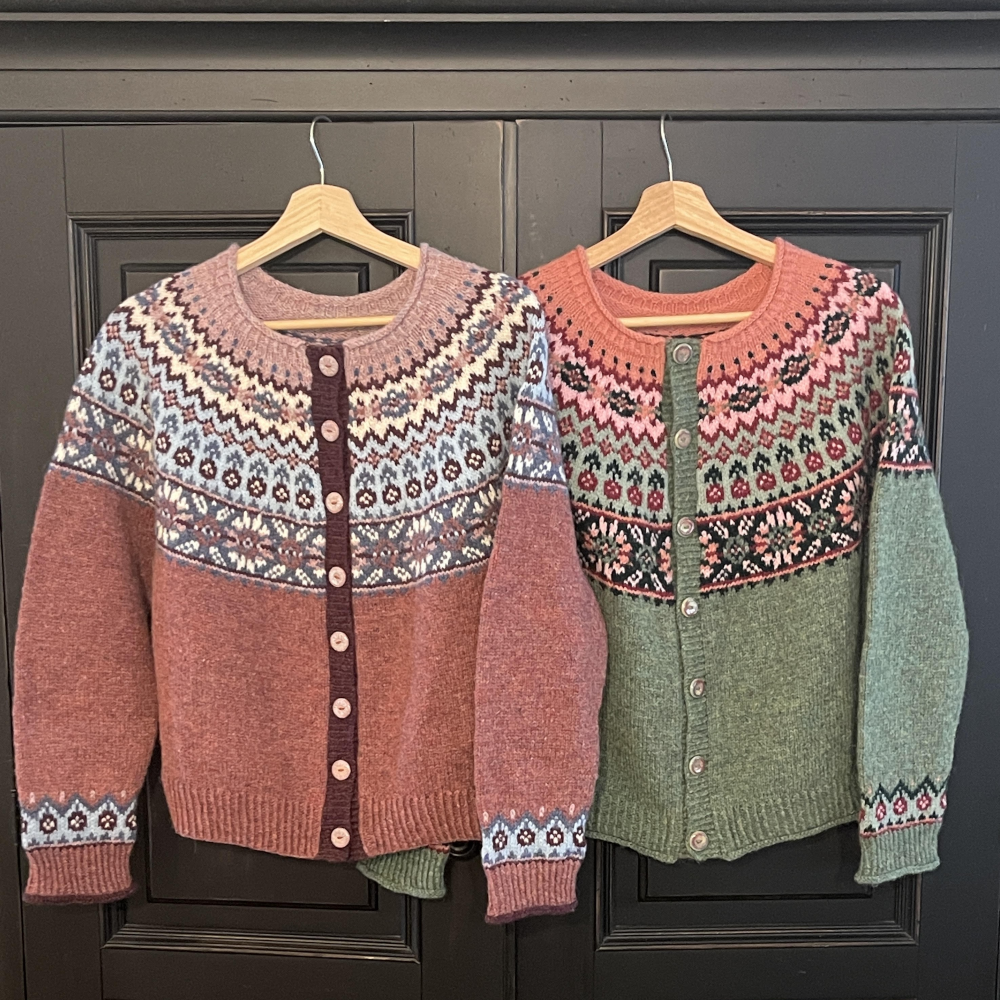
The Fruition Cardigan is a circularly-knit, DK-weight, steeked, stranded knitting design written to be worked from the top down. There are eight adult sizes, each with two colorized charts reflecting the “Cherry” and “Plum” samples.
A rolled edge, twisted ribbing and a few short rows shape the collar. Most of the yoke is knit using traditional Fair Isle technique; roughly thirty percent of the yoke is knit with three colors per round. Within eleven of those three-color rounds, you will encounter long floats. If you already have a method you like for knitting with three colors and catching floats, great – carry on! If not, this YouTube video of mine, “Knitting with Three Colors and Catching Long Floats” will take you through the method I use. If you are experienced with Fair Isle knitting, i.e., using two colors per round, with this method, I think you will find working with three colors and neatly managing floats can become a happy part of your knitting repertoire. Symbols are included on the charts to guide your float management so nothing goes over 1” / 2.5 cm. It is certainly not essential that you use my method. On the other hand, it does work nicely!
Once the yoke is complete, stitches are divided between the body and sleeves. The body and sleeves are all knit circularly in single-colored stockinette stitch, with a short band of stranded color work above the sleeves’ cuffs. Twisted ribbing is worked to shape the bottom edges. Finally, the cardigan steek gets marked, cut open and finished with button bands worked in twisted ribbing.
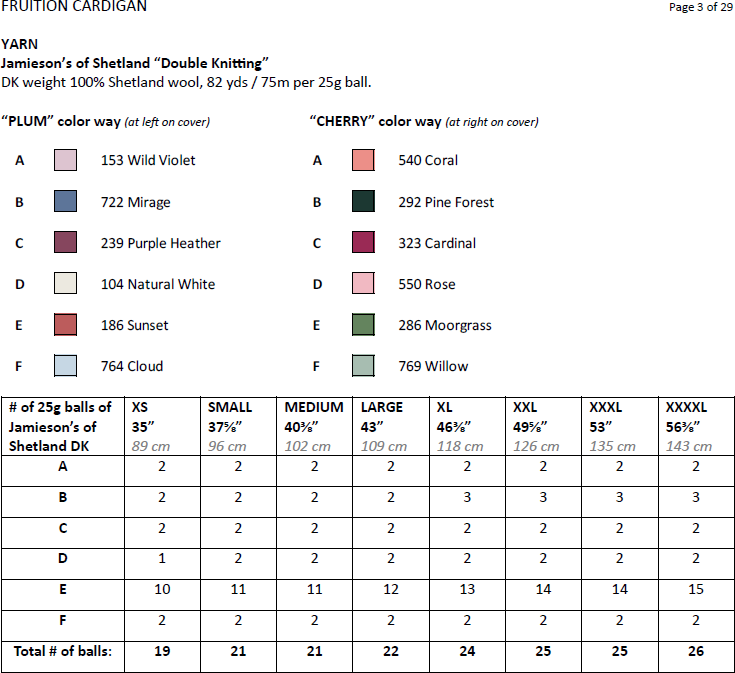
Both samples were knit with Shetland wool which I absolutely adore and highly recommend. Thanks to its “sticky” nature, Shetland wool does not require reinforcement prior to cutting. Some traditional 100% wool yarns might behave nicely without reinforcement, but some traditional wools benefit from reinforcement – at least a bit of needle felting. Soft wools, superwash wools, wool blends, plant-based and artificial fibers unravel easily and require sewn reinforcement before cutting. Thankfully, sewn reinforcement is really a very simple process. Here is a link from my website that will show you my Top Ten Tips for Machine-sewn Steeks. Whichever method you choose for managing your steek, be kind to both yourself and your sweater and take that method out for a test drive on your swatch before using it on your cardigan.
SIZES
Chest: The pattern provides eight finished chest circumferences: 35 (37⅝, 40⅜, 43, 46⅜, 49⅝, 53, 56⅜)” / 89 (96, 102, 109, 118, 126, 135, 143) cm. Ease on samples is 4” / 10 cm. Suggested ease range is 3 to 5” / 8 to 13 cm.
Scheduled for release in late November 2026.
From the Fruition Cardigan pattern:
The Fruition Cardigan is a circularly-knit, DK-weight, steeked, stranded knitting design written to be worked from the top down. There are eight adult sizes, each with two colorized charts reflecting the “Cherry” and “Plum” samples.
A rolled edge, twisted ribbing and a few short rows shape the collar. Most of the yoke is knit using traditional Fair Isle technique; roughly thirty percent of the yoke is knit with three colors per round. Within eleven of those three-color rounds, you will encounter long floats. If you already have a method you like for knitting with three colors and catching floats, great – carry on! If not, this YouTube video of mine, “Knitting with Three Colors and Catching Long Floats” will take you through the method I use. If you are experienced with Fair Isle knitting, i.e., using two colors per round, with this method, I think you will find working with three colors and neatly managing floats can become a happy part of your knitting repertoire. Symbols are included on the charts to guide your float management so nothing goes over 1” / 2.5 cm. It is certainly not essential that you use my method. On the other hand, it does work nicely!
Once the yoke is complete, stitches are divided between the body and sleeves. The body and sleeves are all knit circularly in single-colored stockinette stitch, with a short band of stranded color work above the sleeves’ cuffs. Twisted ribbing is worked to shape the bottom edges. Finally, the cardigan steek gets marked, cut open and finished with button bands worked in twisted ribbing.
Both samples were knit with Shetland wool which I absolutely adore and highly recommend. Thanks to its “sticky” nature, Shetland wool does not require reinforcement prior to cutting. Some traditional 100% wool yarns might behave nicely without reinforcement, but some traditional wools benefit from reinforcement – at least a bit of needle felting. Soft wools, superwash wools, wool blends, plant-based and artificial fibers unravel easily and require sewn reinforcement before cutting. Thankfully, sewn reinforcement is really a very simple process. Here is a link from my website that will show you my Top Ten Tips for Machine-sewn Steeks. Whichever method you choose for managing your steek, be kind to both yourself and your sweater and take that method out for a test drive on your swatch before using it on your cardigan.
SIZES
Chest: The pattern provides eight finished chest circumferences: 35 (37⅝, 40⅜, 43, 46⅜, 49⅝, 53, 56⅜)” / 89 (96, 102, 109, 118, 126, 135, 143) cm. Ease on samples is 4” / 10 cm. Suggested ease range is 3 to 5” / 8 to 13 cm.